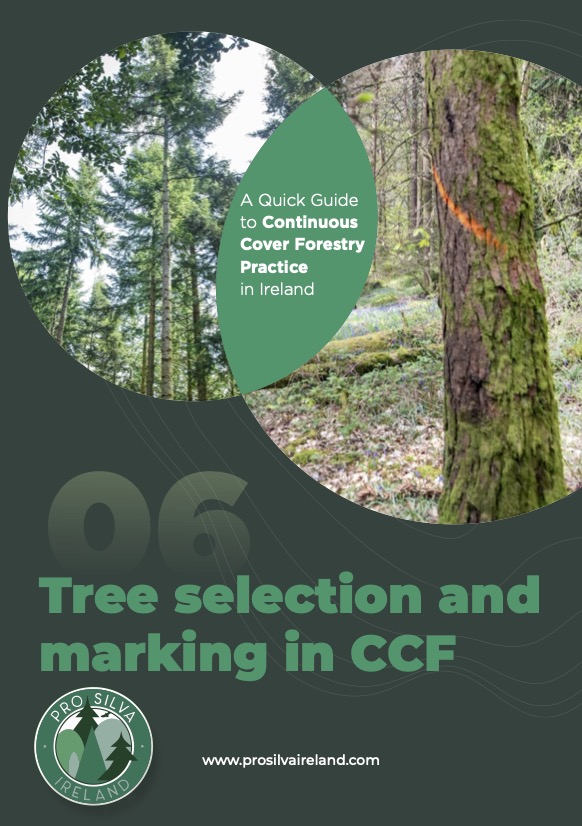
Tree marking

Selective felling

In CCF, tree selection for thinning and harvest is the primary approach for guiding the development of a forest.

In CCF, trees are not removed according to a regular pattern. Instead, felling decisions are made on the basis of each tree’s quality and function relative to its neighbours. These decisions are communicated to the harvesting operators through a standardised system of tree marking.

What is selective felling?

Selective felling refers to the selection of individual trees for removal or retention. 

It concentrates growth on chosen trees, improves overall timber quality in the stand, encourages natural regeneration and maintains a healthy forest ecosystem. Through this process, the forest gradually moves toward a fully irregular structure.

When marking trees for selective felling, foresters assess the needs of individual trees while also considering stand stability, light conditions, forest ecology and wider management aims.

Why selective felling?

Selective felling is fundamental to CCF management because it:

1

Concentrates growth on retained quality trees

2

Increases the overall value of the stand by removing low-grade trees

3

Creates space for natural regeneration

4

Maintains and enhances the forest ecosystem

5

Enhances biodiversity

6

Generates regular income for the forest owner

Tree marking in CCF

Tree marking is the method used to communicate selective felling decisions to harvesting crews. Paint symbols are applied to trees to indicate whether they are to be removed, modified or retained and protected during harvesting.

Pro Silva Ireland has developed a standardised system of tree marks for use by foresters in Irish forests managed under CCF. The system is widely applied in both private and state forests and ensures consistency and clarity across harvesting sites.

Trees to be retained

White or blue paint

Retain on the basis of high timber quality

Quality trees are marked with a white or blue ring around the stem at approximately 2m height. The mark should be clearly visible from a distance.

These trees must not be damaged during operations.

Quality trees are typically identified early—at first thinning for broadleaves and second thinning for conifers—and favoured during successive thinning operations, although selection can occur at any stage.

The ring mark should be refreshed at each subsequent marking. In areas of high visual or ecological sensitivity, a temporary ribbon can be used instead of permanent paint for the duration of the harvesting operation.

Retain for biodiversity (bio trees)

These trees are marked with a white or blue triangle on three or four sides of the stem, depending on tree size. The mark should be visible from all directions.

This mark indicates that the tree must not be damaged during operations.

Only trees of very high biodiversity value (bio trees) are marked; it is not necessary to mark every tree with biodiversity features.

Typical examples include:

  • Veteran trees of diverse species
  • Standing deadwood habitat trees
  • Trees containing nests or dreys of important species (e.g. red kite, buzzard, red squirrel).
  • Underrepresented tree species important for diversity.

Retain to demarcate permanent rack or headland routes

Trees either side of permanent racks or headlands are marked with two parallel horizontal lines on the side of the stem facing the route. These marks are particularly useful in older woodlands where rack routes are unclear or where excessive racking has occurred and some racks are being abandoned.

Note, if a rack-demarcating tree later needs to be removed for silvicultural reasons, the retention mark can be sprayed over with a removal mark.

Trees to be removed or modified

Usually orange or pink paint

Trees selected for removal

These trees are marked at approximately 2m height with coloured diagonal slashes running around the stem and visible from all sides.

Trees are marked for removal to achieve objectives such as:

  • Removing poor-quality or defective trees
  • Favouring higher-quality neighbouring trees
  • Harvesting trees that have reached marketable size
  • Releasing regeneration
  • Improving structural or species diversity
  • Promoting stand stability

Removal to accommodate harvesting and extraction

These trees are marked with coloured vertical stripes on four sides of the stem. These ‘rack marks’ indicate the direction of the proposed machine path or rack. These marks are generally only used in a first thinning scenario but may be used in later interventions to extend or adjust the rack network.

Trees to be ring barked (standing deadwood creation)

These trees are marked with a coloured zig-zag pattern. This mark is used to create standing deadwood by ring barking and is appropriate when:

  • The tree is out of reach of the harvest machinery and access is not cost effective
  • Harvesting would risk damage to nearby quality or bio trees
  • There is insufficient standing deadwood on a site (typically using trees of poor timber quality)

Ring barking should not be carried out close to roads or public walking routes.

Trees for fallen deadwood

These trees are marked with a circular symbol bisected by a horizontal line. This mark indicates that a tree is to be felled and left on the ground. This mark is used where:

  • There is insufficient fallen deadwood on the site (poor-quality or overrepresented species are generally used)
  • A windthrown tree is interfering with a retained tree but has developed microhabitat indicators. Marking it to become fallen deadwood removes the interference while allowing the tree to continue providing habitat as it decomposes.

Trees for standing deadwood (high cut)

These trees are marked with a circular symbol bisected by a vertical line. This mark indicates that the tree is to be cut high to create safe standing deadwood. This mark is used where:

  • There is insufficient standing deadwood on a site
  • A harvester can safely create a high stump (typically around 4m)

High cuts can be used near paths, as there is no risk of falling branches.

Primarily for use on conifer species, which do not pollard.

It may also be used on broadleaves where pollarding is beneficial, for example:

  • To increase vertical structure diversity
  • To suppress side branching on neighbouring quality trees
  • To provide temporary support to a broadleaf tree with a poor stem-to-crown ratio, which would otherwise become unstable if fully released.

resources

Explore further

PDF

Guide 6 Three selection and marking in CCF