By Sean Hoskins
In another small country, not so far from Ireland, there exists a continuous cover forestry (CCF) mecca.
Slovenia, where clear-felling was prohibited in the 1940s, boasts 60% forest cover, with 1 in 5 people owning a forest, and where wolves, bear and lynx still roam the woods.
Thirty Pro Silva Ireland (PSI) members arrived in Slovenia in late September, where they were generously hosted over three days of forests, culture, food and CCF, by Pro Silva Slovenia, the University of Ljubljana’s Department of Forestry, and the Slovenian Forest Service.
The trip was an opportunity to see CCF in action at the individual forest level, where it has been practiced for over 100 years in some cases.
Equally impressive was the impact of a national commitment to CCF management at a landscape level. Slovenian forests not only support a profitable timber industry, but are rich in beauty, nature and wildlife and are deeply embedded in the culture of a warm and open nation.

Slovenian Forestry
Dr. Dušan Roženbergar, Associate Professor at the Department of Forestry, University of Ljubljana, explained on PSI’s arrival that Slovenia possessed several bio and climactic regions, each with a different set of predominant tree species.
These range from a mediterranean climate on the coast, which features broadleaves and evergreen oaks, to the mountainous areas where Norway spruce, silver fir, beech, sycamore and maple are the most important commercial species, along with oak (and formerly ash) in the valleys.
Roženbergar explained that modern Slovenian close-to-nature (the preferred term for CCF in Slovenia) forestry has its origins in the farmer-select approach, which had been practised for hundreds of years.
Each farm owned an area of forest, which was retained permanently, but where timber was felled when needed for farm buildings, implements and infrastructure projects.
A trip to the House of Forest Culture, with Alenka Verdinek of the Carinthian Regional Museum, further informed the group on the history and current state of Slovenia’s forest sector, including the following stats:
Prof. Jurij Diaci, Chair of silviculture and head of the Research Unit at the Biotechnical Faculty, Department of Forestry, University of Ljubljana, then explained how Slovenian forestry had evolved to this point.
The farmer-select tradition had been enhanced in the early 20th century through the addition of modern forest inventory techniques.
“It was invented by farmers with farmer selection, then adopted by foresters who added the controls of inventory,” said Diaci.
A pioneer of this development was Slovenian forester Franjo Pahernik (1882–1976), who led by example as a practitioner managing his 550ha family forest, and later as an advocate for progressive forestry when a member of parliament in the 1930s.
A quote of Pahernik’s hung on the wall of the House of Forest Culture:
“Forest management must be conducted in the spirit of sustainability which means we may only extract interest from the forest, we must not interfere with forest assets. We have to gradually transition from extensive exploitation to intensive, national woodland management.”
Pahernik, 1932

Slovenian Forest Service System
The Slovenians today have achieved national woodland management, where adherence to national policy is both supported and ensured by the Slovenian Forest Service.
The national forest estate is divided into 50ha management units, each with its own management plan produced by the Forest Service. Within each unit, individual properties are also provided with a silvicultural plan based on close-to-nature management.
The silvicultural plan includes the allowable cut by volume over a 10-year period. However, owners can elect when and how much to cut of the allowance but have to inform the Forest Service, who then provide a forester to carry out marking of trees prior to felling operations.
The forest owner accompanies the state forester during marking, the mention of which provoked wry smiles amongst the Forest Service staff present, possibly reflecting on wrangles over which trees to harvest.

Pahernik Forest: going it freestyle
Next stop was the Pahernik Forest itself, the management of which is headed by Diaci for both the university and the Pahernik Foundation. He explained the Slovenian approach to close-to-nature management is via “freestyle silviculture” and this is practised at Pahernik Forest.
This means there is no set prescription of how to achieve close-to-nature management, but rather a “free selection of silvicultural tools”. For example, to achieve management aims at Pahernik forest, they might use an irregular shelterwood in one area and single-tree selection in another.
Diaci said control was maintained through inventory, which measures progress, and the production of a management plan every 10 years.
“Success is very important,” he said.
Pahernik Forest’s dominant species and commercial prospects are Norway spruce, beech and silver fir. Currently, the forest consists of around 82% conifers and 18% broadleaves. Of the conifers, spruce is dominant.
With current and future climate change impacts, and the very real impact of bark beetle, Diaci said now a priority was to spread the risk by increasing the ratios of beech and silver fir.
Previously, in the 1970s and 80s, silver fir numbers had declined due to aerial pollution but currently the main problem is browsing of fir by deer, proved through inventory plots.
“We would like the species ratio to reflect natural species percentages but it is a challenge when the deer have a preference to browse those”, Diaci said.
In response to questions from the group around the effects on profitability from a targeted species shift, Diaci said that Norway spruce was the bread-and-butter species in terms of income, with sawlog earning around €110/m³.
Silver fir fetches about 10% less than spruce but grows well at the site and inventory shows the fir has 10% more annual growth increment than spruce, so over time the outlook is okay.
Although broadleaves earn around 20% less than conifers, the forest management recognises that the risks posed by pests, disease and future climate scenarios are too great to not diversify.
Diaci said only around 85% of the increment is harvested at each harvesting intervention at Pahernik Forest and 80% of output is sawlog.
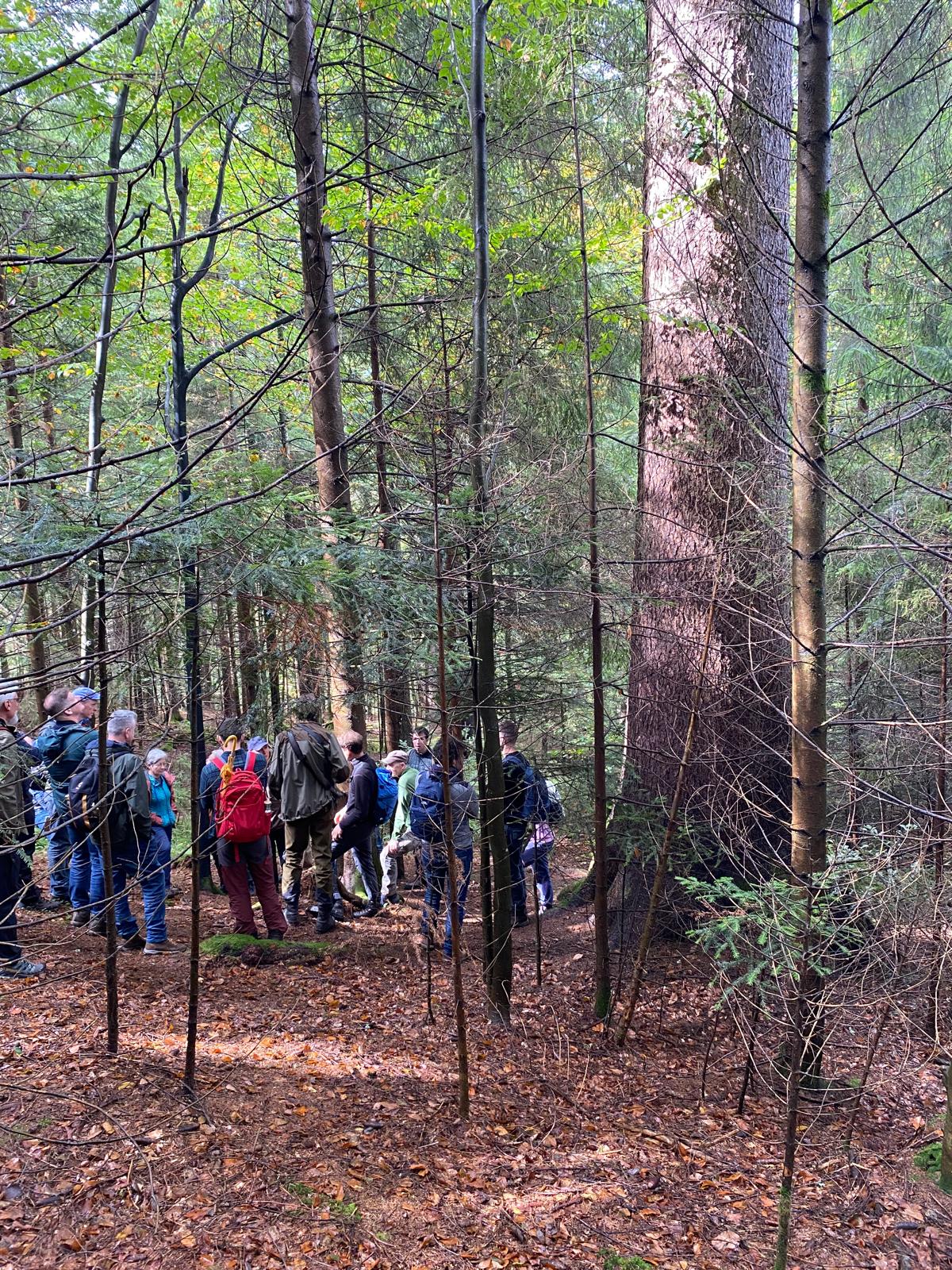
A highlight, in addition to the impressive management, was a stop at the approx. 250 years old ‘Pahernik Spruce’, one of the biggest trees in Slovenia at 62m. This was followed by a hearty lunch of frika, a dense and delicious pan-fried cake of potato and cheese, washed down with Slovenian beer.


Protection Forests
Day two began with a visit to a protection forest, a concept new to most of the Irish contingent but with relevance to our less-stable, upland areas at the head of important water catchments.
In Slovenia, 10% of forest cover is designated as protection forest, and is managed using CCF to physically slow, stop or reduce the impacts of snow avalanche, erosion, rock fall and flooding.
Members of the Slovenian Forest Service Andrej Breznikar and Kristina Sever (who is also President of Pro Silva Slovenia) hosted PSI at Soteska, where a mixed forest on the very steep slope protects a cycleway and train track below from avalanche and rockfall. Below the rail lines flows a significant river, which the forest also aids by slowing the passage of water down the slope and reducing the risk of flash flooding.
The foresters explained that without active felling interventions, trees can grow too large, lose stability and become hazardous.
“If something is wrong with the forest, then the protective function doesn’t work,” Sever said.
Felling can also be used to create physical landscape features that slow, redirect or stop the downhill movement of rock, snow and water: cut stumps are left high to act as mini-barriers against falling rocks and to maintain soil stability through the root system; felled logs are laid diagonally across slopes to slow and redirect rockfall.
Other technical solutions had also been tried to protect downhill infrastructure, but none had proven as good as protection forests.
Because protection forests are typically on very steep ground, log extraction is often not possible or is prohibitively expensive. To ensure works are carried out to maintain protection forests, owners are subsidised by the state.


Pokjuka
In the afternoon the group ascended to the Pokljuka Plateau, a cool, high-altitude region of 1300 to 1600m above sea-level and dominated by spruce.
Here, Forest Service forester, and all-round forest sage, Peter Čadež guided the group through forests facing climate-related challenges including bark beetle, windthrow and ice snap.
Managing a forest with only a 3-month growing season seemed to have bestowed Čadež with a calm and patient outlook; to combat bark beetle the Forest Service want to reintroduce silver fir and beech to the forests through natural regeneration, which Čadež said could take up to 60 years.
While deer are a problem for regeneration due to browsing, they are also needed to bring seeds of the rarer species to the site.
“You cannot have natural regeneration without animals,” said Čadež, pointing to an apple tree that only could have germinated from seed which had passed through the gut of an animal.
While Čadež is patient, he is fast to act when the forest needs it. The scourge of bark beetle has been particularly bad at the site, in part due to the large areas of disturbance caused by ice snap.
The beetles can cycle through two to three generations in a season, depending on the start time of the initial infestation and heat, so it is important to be alert to the first generation.
Trap trees are prepared in advance and as soon as an infestation is detected, they are removed from the woods. To aid in this detection, Čadež had even trained a sniffer dog.
The dog can smell the bark beetle pheromones up to 14 days before there is visible dust around bore holes, he said.
When not patrolling for bark beetle, Čadež engages in regular forester duties, including marking trees for the infrequent thinning interventions.
With heavy snowfalls in the winter and slow growth rates, a careful group selection method of thinning is used. Čadež said one or two trees can be removed from groups, but no heavy thinning; otherwise, snow resilience would be compromised.


Ancient Woods of Mythical Character
The final day saw a long bus ride into the Kočevje region, home to one of Europe’s last primeval forests: Rajhenavski Rog.
Declared a forest reserve in 1892, it has never been clear-felled. The tour arrived at the old Rog sawmill before departing on a 3-kilometre walk to the reserve boundary, guided again by Roženbergar and joined by local forester Katja Konečnik.
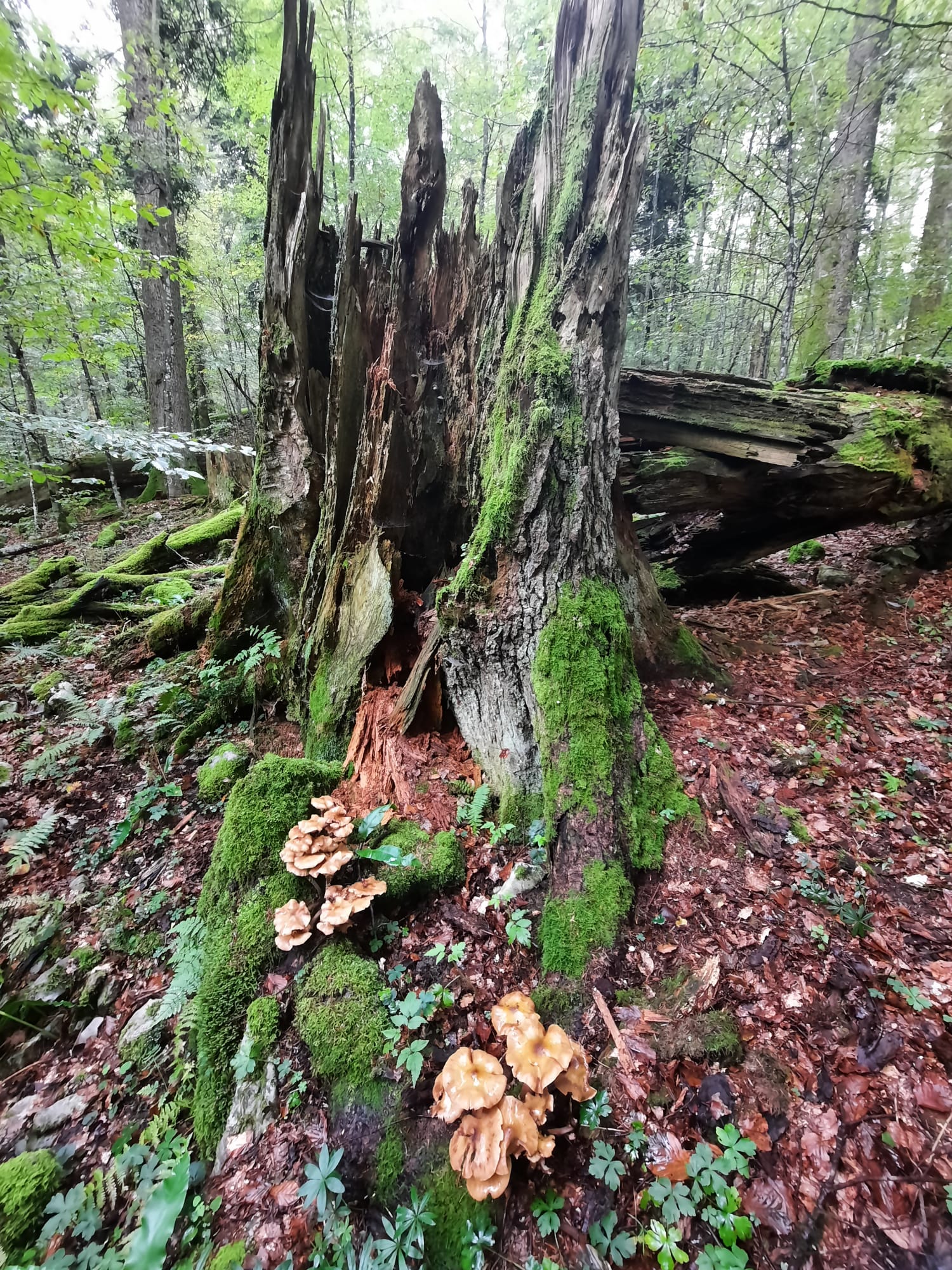
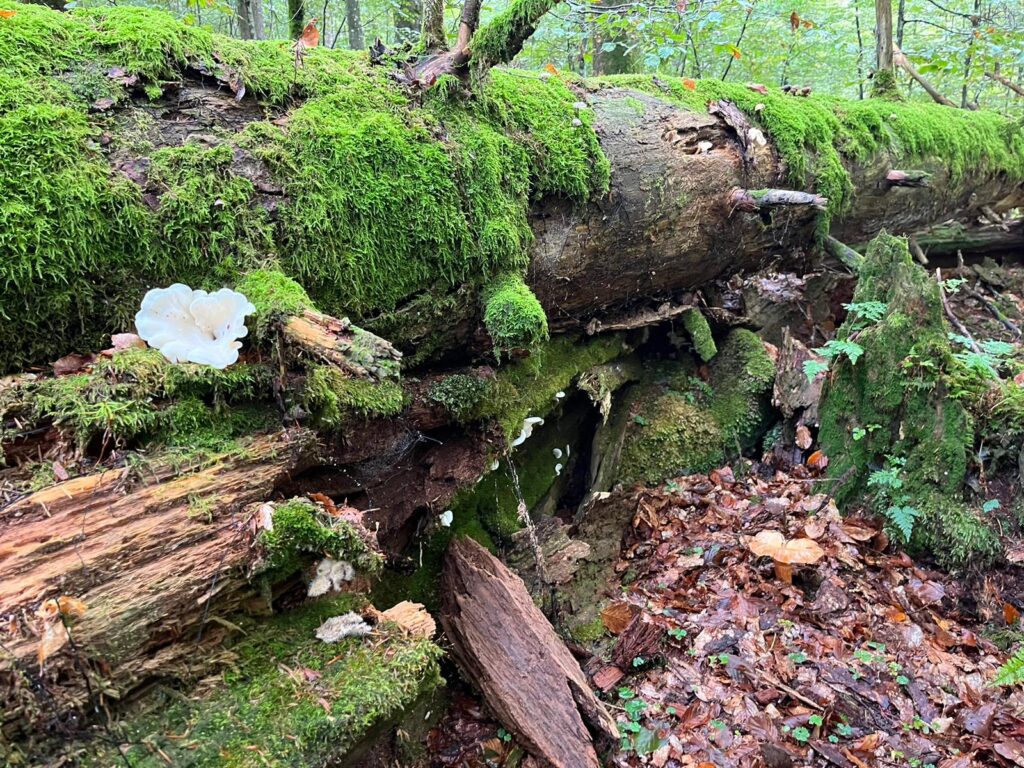
The PSI visitors noticed much more deadwood in the reserve forest; standing, fallen and decaying in every form imaginable. Rather than being seen as waste, this material is considered vital: retaining moisture, storing carbon and providing habitat for countless organisms.
Roženbergar elaborated on the importance of moisture retention in the context of climate change; warmer winters means less snow which means less moisture for regenerating seedlings, which suffer again with hotter summer temperatures and droughts.
The absence of snow also make seedlings more susceptible to deer browsing in winter.
The mention of deer pressure, a problem held in common with Irish forestry, prompted questions about the effects of the country’s large carnivores on populations.
Despite being in an area with bears (claw marks on a rotten tree where bears had been searching for grubs attested) and wolves, deer populations were still too high.
Roženbergar said wolves did hunt deer but had less of an impact than you might imagine. Bears tend to challenge wolves for deer carcasses rather than hunt their own.
The group moved slowly, lingering to enjoy the big trees, fungi and bear signs, and as a result arrived late at the final stop of the tour.


Medvedica: Perspectives of a private forest owner
The afternoon brought a visit to Medvedica, a private forest estate owned by Marija Jakopin and her husband who shared candid insights — and plenty of humour — about managing a large holding amid changing legislation, climate pressures and public expectations.
This private estate demonstrated how close-to-nature silviculture principles were being applied by private owners: promoting natural regeneration, supplementing species through selective planting, and fencing to protect against deer.
The group discussed the impacts of the catastrophic ice storms of 2014 and subsequent windthrow events, as well as the ongoing restoration work.
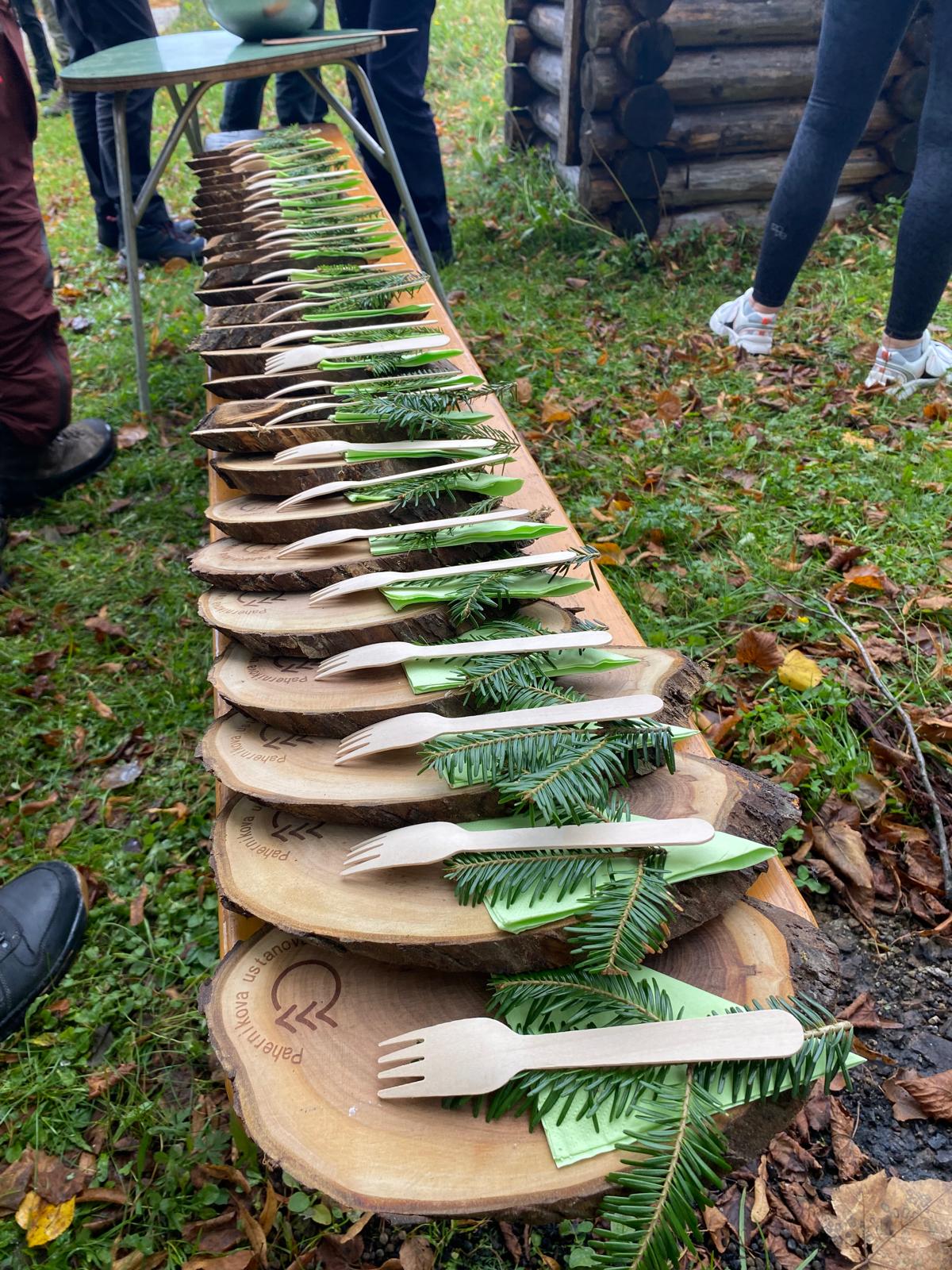
The tour ended in true Slovenian fashion — with a forest picnic featuring venison goulash and roast wild boar, both animals shot on the property and prepared by two of Medvedica harvesting contractors/chainsaw operators, accompanied by Slovenia beer and Irish song.